

Projects
Strengthening Immunisation and Access to Social Protection Schemes
Raah Health & Social Development Foundation works with communities, frontline workers, and local authorities to help vulnerable households access essential public services and government welfare schemes.
This programme has evolved from community-based work on routine immunisation and social protection awareness into a broader service-linkage initiative. In the first phase, Raah supported household surveys, community meetings, and awareness activities related to child immunisation and government welfare schemes. The findings from this work helped identify barriers households face in accessing services and informed subsequent field-level support.
Raah is currently supporting village-level Family ID facilitation camps in coordination with local authorities. Through door-to-door screening, village camps, and documentation support, the foundation helps eligible households, particularly those without ration cards, complete the Family ID process and improve their access to government welfare systems.

Key Activities
- Household screening to identify eligible families
- Village-level camps for UP Family ID registration
- Awareness support on government welfare schemes and public services
- Coordination with Panchayat Sahayaks, local representatives, and district/block officials
- Documentation of barriers faced by households in completing registration
- Follow-up support for families requiring additional facilitation
Key Results
- 33K+ households screened for Family ID eligibility
- 7928 eligible households identified
- 3320 Family IDs facilitated
- Work implemented across 274 villages in Hardoi district
- Earlier community engagement reached 2,887 participants across 86 villages
Community Support for Government Health Campaigns (Periodic support activity)
Raah Health & Social Development Foundation is committed to supporting district authorities and local health departments in strengthening community participation in public health campaigns.
As part of this role, Raah provides field-level support for mobilisation, awareness generation, household outreach, and coordination with frontline workers during district-level health campaigns. The foundation works in close coordination with health officials, ASHA workers, Anganwadi workers, and local representatives to help improve community awareness and participation in government health services.
In recent years, Raah has supported district health authorities during campaigns such as DPT vaccination mobilisation, the Mass Drug Administration campaign for lymphatic filariasis elimination, and the Sewa Pakhwada women’s health initiative. These activities have helped strengthen outreach in priority areas, support frontline workers, and improve awareness of preventive health services among communities.

Community Mobilisation and Social Protection Scheme Linkages
Following community-level survey findings, Raah Health & Social Development Foundation designed and implemented community-based interventions in identified high-priority areas of Hardoi district, Uttar Pradesh. The work focused on strengthening community awareness around routine immunisation and improving access to government welfare schemes and essential public services.
The programme followed a phased approach, beginning with intervention planning, field team preparation, communication material development, and coordination with district and block-level authorities. Raah maintained regular engagement with health officials and local administration to align field activities with local priorities and community needs.
During the rollout phase, Raah initiated field-level activities in selected high-priority areas across eight blocks of Hardoi district. A situation analysis survey was conducted to understand local gaps related to vaccination coverage, access to public services, and community-level barriers. The survey covered more than 7,000 households and helped identify areas with partially immunised children, children missing routine immunisation, and households facing challenges in accessing government welfare schemes.
Based on these findings, Raah organised village-level meetings, household outreach, awareness sessions, and service-linkage support. Community members were guided on vaccination services, government welfare schemes, and local mechanisms for accessing essential services.

Key Activities
- Intervention planning and community engagement design
- Development of communication materials for field outreach
- Field team training and practice sessions
- Situation analysis survey in high-priority areas
- Village-level meetings and awareness sessions
- Household outreach and community mobilisation
- Coordination with district and block-level authorities
- Facilitation support for access to government welfare schemes
Key Results
- Field activities initiated across eight priority blocks of Hardoi district
- Situation analysis covered 7,000+ households
- Activities implemented in selected high-priority areas
- 300+ community meetings conducted
- 14,000+ community members reached, including caregivers, women, and local stakeholders
- Improved awareness regarding routine immunisation, welfare schemes, and essential public services
Key Learnings
The programme showed that community mobilisation plays an important role in improving awareness and participation in public services. It also highlighted that many households require practical facilitation support to access government welfare schemes. The experience strengthened Raah’s understanding of last-mile service barriers and informed subsequent work on Family ID facilitation and access to social protection.
Community Survey on Routine Immunisation and Social Protection Schemes
Routine immunisation remains one of the most effective public health interventions for protecting children from vaccine-preventable diseases. However, some children continue to miss essential vaccinations due to a combination of social, economic, and service-related barriers.
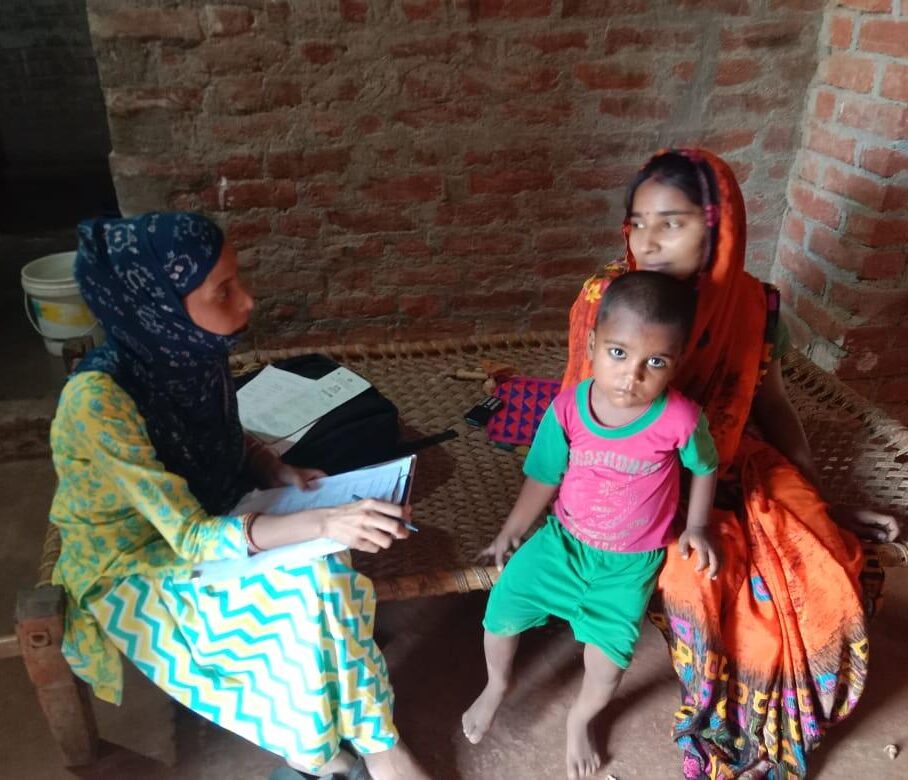
Raah conducted community-based surveys in selected areas of Uttar Pradesh to better understand vaccination coverage, identify zero-dose and partially immunised children, and assess barriers affecting access to health and social protection services.
The survey was carried out across eight low-performing blocks in coordination with district and block-level authorities. It covered more than 11,000 households across 191 health sub-centres and 631 high-priority Village Health and Nutrition Day catchment areas.
The survey focused on households with children aged 6–23 months and collected information on immunisation status, access to health services, awareness of government welfare schemes, and utilisation of available entitlements. The work helped identify children missing routine immunisation, households facing barriers to accessing services, and gaps between eligibility and actual use of government schemes.
The findings from this survey informed Raah’s subsequent community mobilisation and service-linkage activities in Hardoi district.
Key Activities
- Household-level survey with families having children aged 6–23 months
- Mapping of immunisation status and access to health services
- Screening of household eligibility for selected social protection schemes
- Assessment of awareness, uptake, and barriers to government welfare programmes
- Field preparation, pilot testing, and refinement of survey tools
- Training of field teams and supervised data collection
- Data cleaning, analysis, and preparation of field insights
Key Results
- Survey conducted across 8 low-performing blocks of Hardoi district
- 11,271 households covered
- 191 health sub-centres included
- 631 VHND catchment areas covered
- Households screened for eligibility across multiple government welfare schemes
- Identified gaps in routine immunisation coverage and social protection access
Key Learnings
The survey showed that many households were eligible for multiple government welfare schemes, but awareness and actual utilisation remained limited. It also identified the presence of zero-dose and partially immunised children, especially among economically vulnerable households.
The findings reinforced the need for community-level awareness, household outreach, and practical facilitation support to help families access both health services and government welfare schemes.